Our coral gardening training in Sagay was really amazing. I hope I will be able to duplicate some of it at site, but if nothing else it was a great time with all the CRM volunteers and our counterparts in a beautiful marine reserve that is actually working. Here are some pics:
(And just look at how blue and beautiful that water looks!)
One of the coral nurseries we constructed. Hopefully in a year these pieces will be big enough to transplant.
See Rob’s blog for more info and pics from the training. (http://robert-offthegrid.blogspot.com/)
When I came back to site, it was time to do my own coastal assessments, looking at fish, seagrasses and corals. With the help of my BantayDagat crew (local coast guard), counterpart and three PCV friends who visited to help with assessments, we got the job done!
Laying down the transect line for coral reef assessments (the coral were pretty poor in this area).
coral!
Crown of thorns starfish - they love to eat corals and run amuck in areas of low fish abundancy.
Blue starfish so pretty!
(all that underwater work left us hungry for some rice and fish, Yum!)
Manggahan is a week long festival in Guimaras celebrating the much loved Guimaras Mango! Guimaras is very proud of their mangos, and even is quarantined from the bringing of outside mangos to the island. It is rumored (on wikipedia so it must be true) that Guimaras mangos have been served in the White House and Buckingham Palace.
Yummy Guimaras Mangos!
The week started out as any other Filipino festival does, with a parade!
Mango tribe
Corn tribe
Indigenous tribe
Every day was a different event, including local band competition, Ms. Guimaras Competition, island talent show and more, all culminating into the famous and much anticipated Eat-all-you-can-mangos (for 60 pesos lang)!
However the eat-all-you-can-mangos were a little too popular as they quickly ran out of mangos! My friends and I were certainly not going to let that stop us from our eating contest, so we ran to buy the little bit of sweet mangos they had left (they had plenty of green/unripe mangos that Filipinos also love to eat... with soy sauce) and bought enough to have our own mango eating competition. In this case I think pictures really do describe more than words....
He is really into the competition
Finishing off another mango!
juicy and sweet!
Digging in to mangos!
And of course the garbage compactor that is Jensen ruled us all by eating 7 mangos (about a kilo and a half). Needless to say we had a pretty great time hanging out with other visiting PC and JICA volunteers. My roommate and I even wore kimonos to the festival one night! (I mean how many opportunities do you get to wear a kimono?)
Kimono time
The weekend following the Manggahan Festival was Easter weekend, which Filipinos like to celebrate by attending a Pagtaltal event. Pagtalal is a reenactment of the crucifiction of Jesus. Jordan has their own well known version of such an event, attracting visitors and tourist every year. It is quite a day since it starts out in the morning at the bottom of the the island and then you follow the actors as they act out the events leading up to the crucifixtion, at the top of one of the highest points of Jordan. It was a very hot and sunny 6 hour walk but quite the experience. The people who perform do it every year as volunteers for their church. Def not something you see in the states!
Pagtaltal
So as you can imagine with all of these events going on, there has not been much work to do, but I have my PC training going on for the next two weeks, followed by biophysical assessments, and my parents and brother visiting in June (yeah!).
I will keep you posted!
Halong gid!
P.S. Hope everyone had a Happy Earth Day! I know I did! I helped my Provincial Gov plant over 800 mangroves in one of my coastal barangays.
Celebrating Earth Day with my co-workers and community members
Wow another month has come and gone and it is already April!
There is good news and bad news to report. The bad news is that my Solid Waste Management project that got approved for funding got postponed. It is still approved and will eventually get done (hopefully) but for now the funds have been “reallocated” to another project that the LGU deems of higher priority. However this news is not all bad. I was feeling a bit overwhelmed before: trying to push the implementation of my solid waste mgt project while also trying to plan when I was going to do coastal assessments, and I have also been busy visiting all of the schools in town, presenting on solid waste and composting. Now I can focus on the coastal assessments and go back to solid waste later once I get the funds again.
Talking to the kids about composting and solid waste management. They laugh everytime I talk in Ilonggo!
They look so attentive don't they..
Also a lot of my time lately has been focused on Solid Waste Management recently. Like I mentioned, I have visited just about every school in Jordan giving presentations on Solid Waste Management and composting. And I recently helped the municipal engineer to establish some composting bins made out of tires at our municipal building. So this will be a nice change of pace going back to CRM (coastal resource management).
The compost bins behind my office, made from recycled tires.
Physical assessments of the coast is probably most CRM volunteers favorite thing to do because it involves getting in the water and looking at coral reefs and seagrass. However it is also one of the most frustrating things to plan because trying to find all the necessary supplies can be a hassle! Even though performing assessments in coastal waters is mandated by the national government, most LGU (that’s Local Government Unit for those that forgot) don’t have the proper supplies or know-how to do it.
Coastal assessments are important for assessing the effectiveness of established marine reserves and the information gathered will be used to update the Coastal Resource Management Plan. I also want to assess a new area so I can make recommendations for establishing a new marine reserve.
During training we learned how to do these assessments and used supplies supplied by Peace Corps (see earlier blog post - Finding Nemo). Now it’s time to do assessments in my municipality. I have been waiting for the good weather (and calmer waters) of the summer season to do this. But the summer weather was late in getting here and the rainy season is fast approaching. And the next two months are already very full with activities! Next week is Manggahan Festival, celebrating Guimaras’ sweet mangos. It is a full week of events including dance competitions, live bands, mango eating competition, Filipino celebrities, carnival rides and a day of all-you-can-eat-mangos! After Manggahan is Holy Week, ending with a reenactment of the Crucifixion of Christ – whether this will be using nails or rope is yet to be known! I will also be gone for two weeks in May for various PC training events.
All these weeks of festivals and conferences leave me little time to do coastal assessments so I am trying to get everything planned. And the planning process takes a good deal longer here since it takes twice as long for someone to get back to me about supplies and even when someone says they have transect lines that I can use, it doesn’t always mean they actually do. Often times items are misplaced, broken, or in use somewhere else even though they were supposed to be saved for me.
But I digress… I am sure you are wondering what this good news is that I mentioned earlier. Well I moved out of my host family house and am now living in my own place! As mentioned before I loved living with my host family but have also been really wanting to get out and have my own place. This is part of American culture that many Filipinos just don’t understand. “Why would you want to move away from your family?” “Aren’t you scared to live on your own?” These are the questions I get. At the core of Filipino culture is family. Family members don’t move out until they get married, and even then often new couples continue to live with their parents. Even when they eventually do move out, usually they build a house right next store to their parents’.
This is of course quite different from the average American household, wherein parents from day one are raising their children to be independent so as to be ready for that fateful day when you move out on your own. I remember looking forward to moving out and having my own place, and I know my youngest brother is feeling the same way right now. I try to explain to locals that my American family is just as close, we just don’t all live together in the same house, and we strive to be able to be independent. But this is just one example of the cultural differences I run into on a daily basis!
So I moved down the street to a nice little house. I also got a dog and a roommate. My roommate is just for the month of April but it is nice to transition to living on my own here by having a roommate first. And she is a foreigner to the Philippines as well. Chie is a JICA (Japan’s version of PC) volunteer. Her site is in the city but she has a month off and wants to concentrate on learning Ilonggo, so she asked if she could move in with me for a bit so that she could take language lessons with my language tutor. It is a really neat experience living with a volunteer who is from another country. We take turns cooking American and Japanese foods and help each other with language.
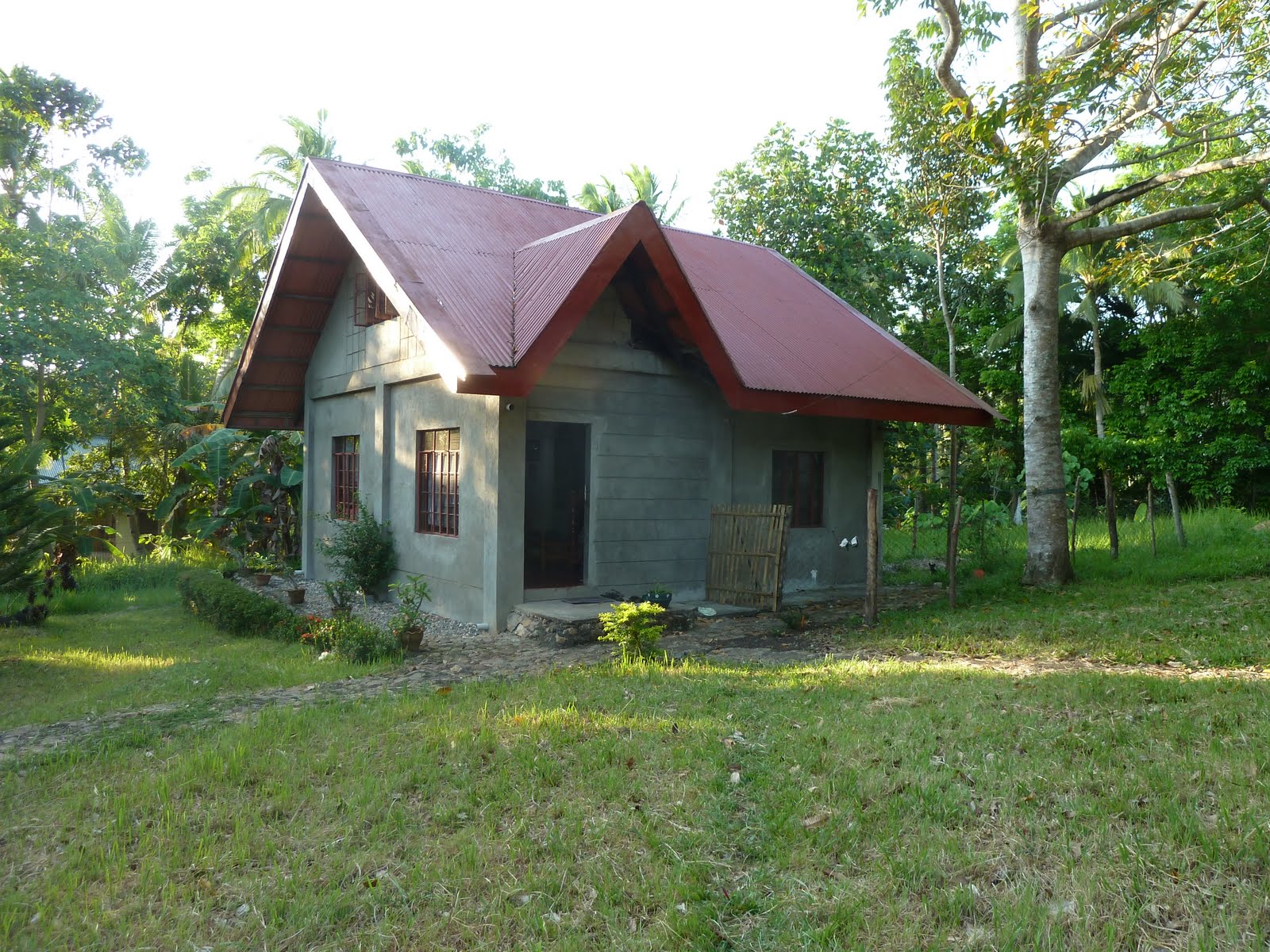
My new house!
The compost bin I set up behind my house, also using recycled tires.
My Japanese roommate, Chie, with my new puppy, Turtle.
I find myself keeping some American ways and practices but also adopting some of the Filipino ways that I have learned while living with my host family. I am also learning how to buy food and cook in the Philippines. Going to the market is an adventure every time! I never know what fruits, vegetables and fish are going to be available or if they will be selling chicken. And many of the produce is new to me so, with the help of Chie, I am learning how to cook different types of food. Another great thing about having my own place is that my friends can visit me, which they plan on doing for Manggahan Festival. The festival is Guimaras’ highlight of the year and I can’t wait to pig out on sweet mangoes! Yum! I will be sure to take lots of pictures for my next blog entry J
So again there has been quite a lapse since my last post, but it's definitely a good sign because I have been staying very busy with work and all.
Good news today... I got my project approved for funding! Yeah!!!!
But I guess I should start with what this said project is... a few weeks ago, while doing fisherfolk registration at a coastal barangay, I noticed the waste segregation bins around this particular barangay actually had segregated wastes in them (most of the bins around town have a mixture of plastic and leaves in them, indicating segregation is not really occuring). So I arranged a meeting with the person responsible for the effective waste segregation. He is a councilman in the barangay and we are very well acquainted since he also is the president of the Municipal fisherfolk organization. He gave me a tour of the barangay's solid waste management and told me how he implemented and managed it. There was successful waste segregation but the compost piles were not actually composting, but rather just sitting in heaps of leaves and branches. But the general waste segregation was working so good, I had to try to replicate it on the other barangays.
After finding out what the Jordan Ecological Solid Waste Management Board was and that they also had a yearly budget of 250,000 pesos to fund related projects, I immediatley set to writing a project proposal. The board met today and I presented the project, which would require an estimated 92,000 pesos. The board loved it and it was approved for funding! Although knowing Filipino timetables, I am not exactly sure when the funds will be available for me to start the project, but the big victory here is that it will happen!
So what is this magical project you ask?
It is a Solid Waste Management Project that includes IEC (information education communication) and waste segregation for all of the coastal barangays. I will have an IEC presentation informing residents about why burning and burying (because so many still burn their trash right in their front yard) their trash is bad and why waste segregation is good. I will also teach them how to properly segregate trash and how to compost. Following each meeting there will be a community clean-up in that area. Next we will be implementing waste segregation bins and composting bins throughout each barangay as well. So hopefully what we present, they will implement.
I am very excited about the prospect of this project and will continue working on getting it done. Meanwhile I am also helping my sitemate with a project. Her office (social services) is giving a 2-day workshop in all the barangays on "Effective Parenting" and they asked me to be a resource person for the environment. So I have been giving presentations on "keeping a healthy environment for you and your children".
And I am preparing to move out of my host family's house. I will be moving next month to a house near the nipa hut I discussed in my previous post, and another PCV will be living next door in the nipa hut :)
So that is all for now, hopefully next time I post there will be lots of these in my coastal barangays:
Successful waste segregation in the Philippines
P.S. Shout out to Sam! Miss ya girl and I will be seeing you in Taiwan soon enough!
So the days have been going by much faster lately (as is evidence of my lack of posts). Along with continuing to have community meetings in each of the coastal barangays in my municipality, it has also been festival season in the Philippines, filling up both the week and weekend with lots of activities! So here is a recap of some of the goings on:
Tour of Guimaras -
Old lighthouse left over from the Spanish rule. The markings warn it is not safe to climb the stairs.
Among the lighthouse ruins.
The Pas-Pas, our tour vehicle around Guimaras.
Historic Navalas Church
Buenavista Foundation Day Festival -
Motorcross racing for Buenavista Foundation Day Festival. It was very muddy!
Yeah Fireworks!!!!
Dinagyang Festival in Iloilo City -
Posing with some Ati (indigenous) dancers.
Biking around Guimaras -
At the top of the falls.
Makopo falls, right down the street and a short bike ride away from my house.
We also stopped to do a bit of mini golfing... on a cement course. But I did get a hole in one!
And just to prove that I really have been getting work done amongst all the festivals, some pics from some of my community meetings -
My wheels for work activities.
Barangay Sinapsapan community meeting.
Barangay Lawi community meeting.
Barangay Morobuan community meeting.
I have also been spending time with my host family. Volunteers are required to live with host families for our first three months of service, at which point we can choose to move out. As my three months mark is coming up, and I have found a nice nipa hut to move into, I have decided to stay living with my host family for a few more months. I have come to really feel apart of the family as I help out with cooking dinner, play games with the kids, and have cultural conversations with my host parents, not to mention that I have my meals bought for and a pretty nice room to stay in :)
My host mom, Helen, also works at the municipal office, as the head treasurer. Dennis, my host dad, works the family farm, which includes pigs, chickens and Dobermans. Sometimes in the evening I play with my host siblings, Tricia and Andre. Tricia especially likes playing the connect-4 game that I bought the kids for Christmas. She is very smart and has the highest math scores at her school. Andre is always getting into trouble but he is definitely entertaining to say the lease!
Sometimes in the evening I go with my family to Helen’s sister’s house. Lots of Helen’s extended family lives in a compound down the road from us; we go there a lot for birthdays and other celebrations, where we eat a lot of good Filipino food! And because it is a sin to not have enough food at a fiesta, there is always plenty of food to be sent home with afterwards J
My host dad says Hi!
Tricia is so cute!
Andre, probably up to no good!
My host mom with her niece.
I do want to try living on my own in the Philippines and look forward to moving in to my nipa hut, but I am not in any hurry to move out of the house yet. Though the hut I will be moving into is conveniently located right down the road from both my current host family and sheila, my language instructor. That way I can still come by the house and participate in celebrating all of the family birthdays and holidays that I enjoy so much!
And to end on a side note, Helen bought me and the kids some Lays packs the other day. I was pretty excited for some American chips, or any chips that don't taste like some kind of seafood.
Yummy Lays!......
However upon closer inspection of the chips......
Nevermind. yeah that is def sushi flavored......
Well that's all for now, I will try to post again soon!
Now that the holiday season is over and people are back to work, I prepare for my month of community meetings. Having meetings with the coastal barangays is something PC encourages us to do initially at site as a way for us to not only get to know the community people we will be working with, and they get to know us, but also as a means for us to assess the resources and needs of the people. I am fortunate enough to have a very proactive municipality who helped me to plan dates for these meetings the first week I was at site. So I have been excitedly awaiting for the month of January and a chance to really begin my work here.
My first meeting was this past Thursday and I will continue to have meetings every Tuesday and Thursday until I have met with all 8 of the coastal barangays in Jordan. I prepared for my first meeting by deciding the activities, making an agenda, translating everything in Ilonggo (thanks to my language tutor who lives down the road from me), making posters, and gathering supplies.
I was of course nervous about how the meeting was going to go especially with it being the first of eight. The fisher families, my target audience, represent the poorest of the poor here. Although English is taught to children starting in kinder, many fisher families cannot afford to go to or stay in school, therefore many of them understand little English and speak even less. Some cannot even read and write. Therefore I was very nervous about my communication barrier, but thankfully three of my co-workers including my counterpart accompanied me and were able to help out in translating whenever I needed. This is also why it was so important that I translate all of the posters into Ilonggo and speak as much of it as I can.
We held the meeting at the local church and when it was time to start the barangay captain rang the bell. And wouldn’t you know it everyone in the coastal sitio showed up, and I mean EVERYONE: fishermen AND their wives and families (I was afraid only the men would show). The barangay captain was there along with BFARMC (fishermen organization) members and kagawad (barangay council) members. 53 total in attendance!
To start things off, I did my introduction (in Ilonggo) and had them all introduce themselves. This served as a sort of ice-breaker so that hopefully they would be more apt to participating later in the discussions (a handy strategy I learned from the best facilitator I know, thanks Becky!) This type of introduction I think is especially important in the Filipino culture, where so much emphasis is based on being part of the community and knowing the people. For this reason I have learned that when I introduce myself I always include what family I am living with. Family is the main tie that holds Filipino communities together (especially since everyone it seems is a relative of everyone else). It is how they think of you as a member of the community rather than an outsider. One of the greatest parts of the PC program is having us live with host families. Not only do we learn more of the language and culture this way, but we also are seen as a member of the community and therefore respected and protected as such.
After introductions, I asked the community members to list resources and needs in their barangay. Then I had a list of activities under columns of how often those activities occur. I asked them to each come up and put a tally if that specific activity occurred: often, sometimes, or never. The activities were things like: small fish catch, needing to travel farther to find catch, commercial fishers coming into municipal waters, trash on the beach, use of illegal fishing methods, etc. And it ended up being my absolute favorite part! Everyone wanted to come up and put their tally. They wanted their opinion counted. And I was able to encourage those in the back to participate by giving them markers and ushering them to the front of the room. It was an amazing sight to see all of them huddle around the poster, reading the activities and adding their tally.It was exciting to watch the community actively participate in identifying and managing their resources.
The next activity I had them do was to list what they wanted for their community and among the top things was the establishment of a marine reserve. I asked if we placed one there would the community support and monitor it and it was an overwhelming “yes”. Then they made their community map, which they really got into and were very proud of, identifying all of their resources and places of importance, such as school, church, and of course, basketball court (which also doubles as a dryer for crops like rice).
Our final activity was to outline a community plan. This was my counterpart’s idea, to have people list what they wanted for their community. Of course I was thinking they would list similar things that we had discussed during the meeting, like establishing a marine reserve and keeping their beaches clean. However, instead they listed things like “to be a more friendly and loving people”, “to lead their lives according to God’s will”, and “to obey our parents.” I thought it was a very good wrap up for the meeting; we started out with individual introductions, had discussions about their coastal resources, and ended with the community reminding themselves they, above all, wish to live as a “friendly and loving” community – that is the Filipino people for you.
I am really happy with the way my first meeting went and am very hopeful and excited to visit the rest of the coastal barangays in my municipality.
Wish me luck!
Halong as always.
P.S. Shout out to my readers at NA Elementary School! Thanks for your support and helping me to accomplish the third goal of PC: to spread cultural awareness and understanding to my American friends :)
Our office Christmas Party was Thursday, ending the work week before Christmas. Everyone was supposed to bring a food contribution. It has been hard to get in the Christmas mood here, being away from family and it being so warm (it feels almost unnatural to be sweating in December) so I decided what I needed to help me feel the season was to do some holiday baking. My language teacher, Bebet, has an oven and she agreed to let me do my baking there. I decided to make sugar cookies and magic bars.
When I arrived to Bebet’s house there was another visitor already there. Her name is Waning and she is a manogluy-a, a type of local healer. There are many types of local healers, referred to as kwak-doctors (seriously that is what they are called). This particular healer uses ginger and so is therefore called a manogluy-a, “manog” meaning “one who gives a service or aid” and “luy-a” which means ginger.
Waning was there to attend to Bebet’s daughter, Sam, who has been sick with fever for some time. Modern medicine was not doing much so Bebet said she called on Waning as a last sort of effort. There were a variety of leaves wrapped on Sam’s head using a bandana, and Waning was rubbing a piece of ginger all over her and talking fast.
I told Bebet I have always wanted to meet a native healer. She asked me if there was any ailment that I would like to have Waning look at while she was there. I have a past of back problems, stemming from mild scoliosis and, what I have been told, a “bulging disc”, whatever that means. Doctors tell me I just need physical therapy. But here I was in the presence of a native healer in the Philippines; why not get a second opinion?
So Waning asked me to take the piece of ginger and hold it in my hand. After doing so, she took the ginger from me and began to rub it all over me, just as I had seen her do to Sam. Then she took the ginger and whispered to it for a while. I could not understand what she was saying, and Bebet told me she was speaking Kinaria, which is a another dialect of Hiligaynon.
Then Waning told me (through Bebet’s interpretation) that my back aches were due to “bad air being trapped” in my muscles. I asked her what causes this and she told me that it is due to imbalance, or as we know it, stress. She said I didn’t need another healer, that what I needed was meditation and a good back massage. Then she proceeded to massage my back and rub menthol oil on it. When she was through, my back felt much better!
After my great massage from the manogluy-a, it was time to get baking! Heart, Bebet’s other daughter, was my assistant baker. She was so interested in learning how to bake and had a real knack for it so I let her take over a lot of the mixing and adding and just helped her to follow the recipes. She found some cookie cutters in the back of the cupboard and we made heart and star-shaped Christmas cookies. Then we dyed red and green frosting. Heart really enjoyed decorating the cookies for Christmas. We also made magic bars, with a few substitutions since some of the ingredients were hard to find, including using Guimaras grown cashew nuts instead of peanuts, still very delicious!
It was fun to share the tradition of holiday baking and to learn about some of the native local healers here in the Philippines. Now my back feels great and my holiday treats were a hit at the office Christmas party!
That's all for now. I wish everyone Happy Holidays and a Happy New Year!